
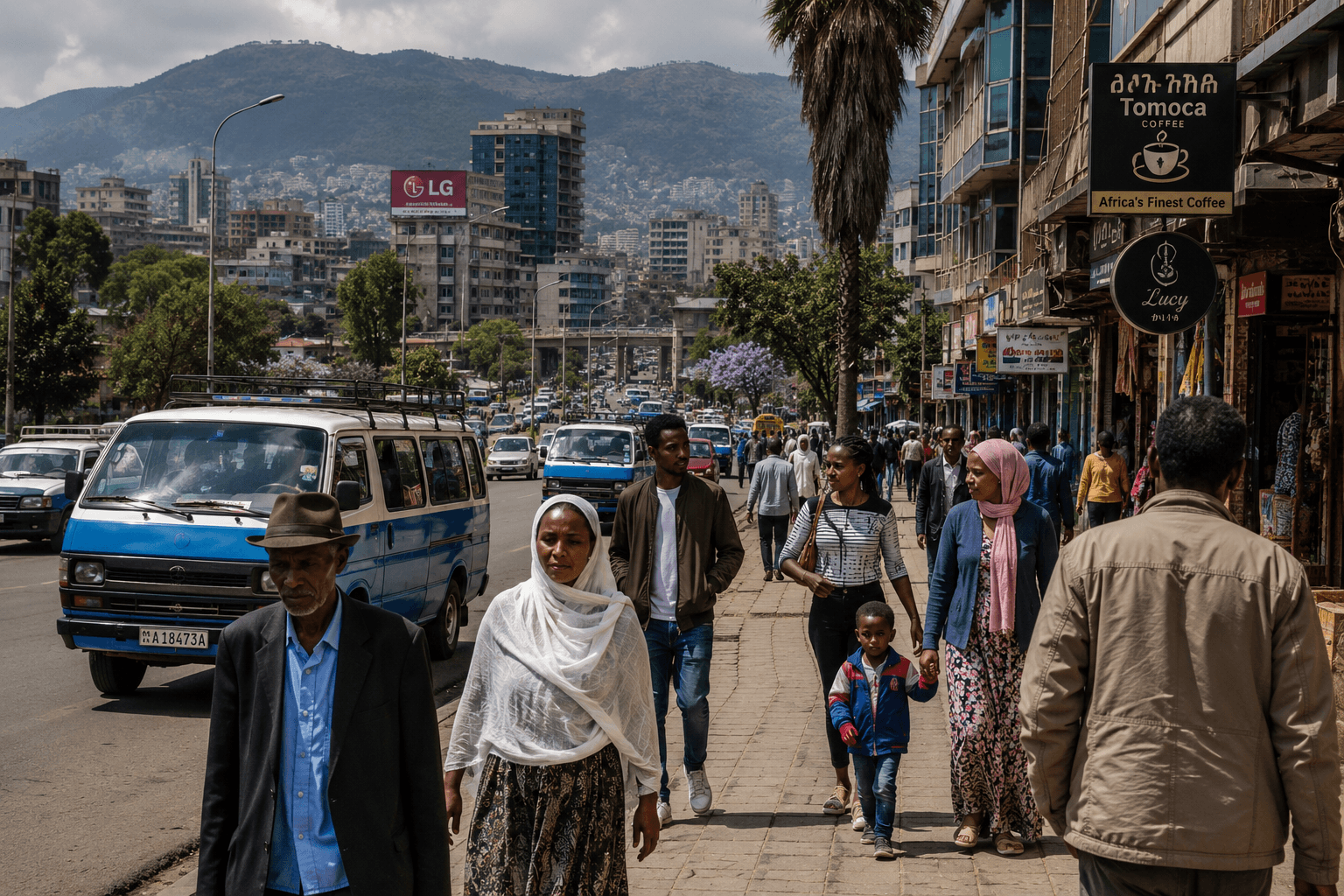
The first surprise about Addis Ababa may come before you’ve even properly seen the city.
You step outside, expecting the heat of an African capital, and think: Why is it cold?
Welcome to Addis.
Ethiopia’s capital sits more than 2,300 metres above sea level, and that altitude explains quite a lot: the cool mornings, dramatic afternoon clouds, surprisingly chilly evenings and the slightly breathless feeling some visitors experience during their first few days.
But altitude is only the beginning.
Addis Ababa is one of those cities that makes considerably more sense after you’ve spent some time in it than it does from photographs.
It can look chaotic and unfinished in one street, modern and prosperous around the next corner. You can drink excellent coffee for very little money, sit for an hour in traffic, encounter extraordinary hospitality, eat with your hands, hear several languages during one short journey and discover that the distance shown on your map tells you almost nothing about how long it will take to get there.
For a first-time visitor to Addis Ababa, here are some things worth knowing before the plane lands.
Addis Ababa Is Much Higher Than You Think
At roughly 2,300–2,400 metres above sea level, Addis Ababa is among the world’s highest national capitals.
Visitors sometimes arrive expecting tropical heat because Ethiopia is in Africa.
Addis has other ideas.
Temperatures are generally moderate, and nights can become genuinely cool. During the rainy season, particularly from June into September, a sunny morning can turn into a wet and chilly afternoon surprisingly quickly.
Bring something warmer than you think you’ll need.
A light jacket or sweater is useful even when daytime weather looks pleasant.
The altitude itself can also affect newcomers. Some people notice mild headaches, tiredness or breathlessness, particularly when climbing stairs or walking uphill.
Usually the sensible response is simple: don’t plan your first morning in Ethiopia as though you’re training for a marathon.
Give yourself time.
Don’t Judge Distance by Kilometres
Your hotel is five kilometres from the restaurant.
Excellent. Twenty minutes?
Maybe.
Or perhaps an hour.
Traffic is one of the realities of Addis Ababa. Road construction, congestion, minibuses, pedestrians and the sheer number of vehicles can make apparently short journeys surprisingly long.
This matters when planning appointments, airport journeys or dinner reservations.
If somebody in Addis tells you to leave early, listen to them.
The city has changed enormously over recent decades, with new roads, buildings and major infrastructure projects reshaping whole areas. That development can also mean temporary diversions and construction.
Addis is not a city where you should calculate travel time purely by looking at the distance on Google Maps.
Bole Isn’t All of Addis Ababa
Many international visitors first encounter Addis through Bole.
Bole International Airport is there, along with hotels, restaurants, cafés, shops and nightlife. For somebody arriving for the first time, it is a convenient base.
But don’t make the mistake of thinking Bole represents the whole city.
Addis contains neighbourhoods with very different personalities.
Piassa has an older urban character and a long commercial history, though major redevelopment has been transforming the area.
Kazanchis mixes hotels, offices, restaurants and international institutions.
Mexico is busy and commercial.
Merkato, traditionally described as one of Africa’s largest open-air market areas, is an entirely different experience again: crowded, energetic, commercial and potentially overwhelming for a newcomer.
Then there are countless residential neighbourhoods where ordinary Addis life happens away from tourist itineraries.
Spend your entire visit moving between an international hotel and restaurants around Bole and you’ll see Addis Ababa.
You just won’t see very much of it.
Coffee Is Everywhere — and It Is Serious Business
You don’t have to search very hard for coffee in Addis Ababa.
It tends to find you.
Ethiopia is the birthplace of Arabica coffee, and coffee culture ranges from the traditional buna ceremony, where green beans are roasted and coffee is prepared in a clay jebena, to bustling cafés serving espresso and macchiato.
The Ethiopian macchiato deserves particular attention.
Italy’s occupation of Ethiopia in the 1930s left some culinary influences, but Ethiopians took the macchiato and thoroughly made it their own. In Addis, it can be beautifully layered, sweet if you want it, inexpensive and extremely easy to become accustomed to.
This produces a dangerous phenomenon.
You stop for one coffee.
Then someone suggests another.
Then somebody else wants to meet you at a café.
By evening you’ve consumed enough caffeine to negotiate an international treaty.
Coffee in Addis is social. Don’t always treat it as something to drink and immediately leave.
You Will Probably Eat From a Shared Plate
If you’re unfamiliar with Ethiopian food, your first proper meal can look intimidating.
A large piece of injera, Ethiopia’s soft, slightly sour fermented flatbread, arrives covered with different stews, vegetables, meat dishes and sauces.
Where is the knife?
Where is the fork?
Often, you don’t need them.
Tear off a small piece of injera with your right hand, use it to pick up some food, and eat the whole thing together.
Sharing from one large platter is normal and can make eating surprisingly sociable.
Don’t panic about technique. Nobody was born knowing how to pick up shiro with injera without depositing half of it somewhere unfortunate.
You’ll improve.
One thing worth knowing is that Ethiopian Orthodox Christian fasting traditions have created an extraordinary range of plant-based dishes. On fasting days and during fasting periods, restaurants may offer yetsom food without meat or animal products.
Vegetarians and vegans can eat extremely well in Ethiopia.
People May Feed You
Then there is gursha.
A person takes a piece of injera, wraps some food inside it and puts it directly into someone else’s mouth.
For visitors encountering this for the first time, there can be a brief expression of:
What exactly is happening here?
Don’t worry.
Gursha is a gesture of affection, friendship or respect. Family members and friends may feed each other this way.
You aren’t required to perform it with strangers, and not every meal involves gursha.
But if an Ethiopian friend offers you one, understand the spirit in which it is intended.
It is considerably more affectionate than someone stealing a potato from your plate.
Addis Can Feel Both Traditional and Very Modern
One of the mistakes foreigners make about Ethiopia is expecting to encounter a country frozen in tradition.
Addis destroys that idea rather quickly.
Young professionals work in technology and finance. People spend hours on smartphones. New apartment buildings rise beside older neighbourhoods. Fashionable restaurants coexist with tiny local eateries. Traditional white clothing appears alongside jeans, business suits and international fashion.
Religion remains highly visible.
So does modern consumer culture.
You might see an Orthodox priest walking past a giant digital advertisement while a ride-hailing driver checks his phone beside them.
None of this is contradictory.
It is simply Addis Ababa.
English Helps — But Don’t Expect Everyone to Speak It
English is widely taught in Ethiopia and is used in higher education, business and tourism, so a foreign visitor can often manage reasonably well in Addis.
But don’t assume everybody speaks fluent English.
Amharic is the city’s principal working language, while Addis is also home to speakers of Afaan Oromo, Tigrinya, Gurage languages and many others.
Learning even a few Amharic words changes interactions.
Selam — hello.
Ameseginalehu — thank you.
You don’t need perfect pronunciation.
The attempt itself often earns a smile.
Money Is More Complicated Than It Should Be
Ethiopia’s financial and foreign-exchange environment has been changing considerably in recent years, so this is one area where visitors should check current information immediately before travelling.
Cards are increasingly accepted at larger hotels, supermarkets and some restaurants, but you should not assume you can live entirely without cash.
Smaller businesses, taxis, cafés and local establishments may still be much easier with Ethiopian birr.
ATMs are available in Addis, particularly around commercial areas, although foreign-card reliability can vary.
Before travelling, check current Ethiopian rules concerning foreign currency, exchange rates, declarations and card access rather than relying on a five-year-old travel blog.
This is one subject where yesterday’s advice can genuinely become tomorrow’s bad advice.
Be Sensible With Taxis and Transportation
Addis has several ways of getting around, from minibuses and the light rail to taxis and app-based ride services.
For a first-time foreign visitor, ride-hailing services can remove one of the traditional inconveniences of Addis taxis: negotiating a price when you have absolutely no idea what the price should be.
Local minibuses are inexpensive and are part of everyday life, but they can be confusing if you don’t know the city or speak Amharic.
The light rail serves parts of Addis, although it won’t necessarily take you where a visitor wants to go.
As you become familiar with the city, transportation becomes easier.
During your first couple of days, simplicity has value.
Addis Is Generally Friendly, but It Is Still a Big City
Most visitors’ interactions with people in Addis are perfectly ordinary and often very friendly.
That doesn’t mean abandoning common sense.
Crowded areas can attract pickpockets. Keep your phone and wallet secure, particularly in busy markets, transport areas and dense crowds.
Don’t wander around displaying large amounts of cash.
At night, take reasonable precautions about where you’re walking and use reliable transportation when you’re unfamiliar with an area.
Political demonstrations and security conditions can change, and Ethiopia’s situation outside Addis varies greatly by region. Always check current travel advice before travelling beyond the capital.
There is an important distinction here:
Being sensible about Ethiopia is not the same as being frightened of Ethiopia.
Hospitality Can Surprise You
One of the things visitors frequently remember about Ethiopia isn’t a monument.
It’s being invited somewhere.
Coffee.
Lunch.
Dinner.
A family home.
Perhaps you met someone only recently and suddenly you’re being told to come and eat.
Ethiopian hospitality can be generous, and refusing everything repeatedly because you’re worried about imposing can sometimes create more awkwardness than simply accepting.
If somebody invites you into their home, bringing a small gift can be a nice gesture, particularly if you’re visiting a family.
You don’t need to arrive carrying half a supermarket.
Fruit, sweets or something suitable for the household can be enough.
And if coffee appears, remember: you may be there longer than fifteen minutes.
Don’t Try to Understand Ethiopia in Two Days
This may be the most useful advice of all.
Ethiopia is complicated.
Addis Ababa is complicated.
It is one of Africa’s major diplomatic capitals, home to the African Union and numerous international institutions. It is simultaneously deeply Ethiopian, increasingly global, rich and poor, ancient in its cultural references and aggressively modern in parts.
You can have an excellent dinner in an elegant restaurant and, twenty minutes later, find yourself on a street that feels like another world.
Don’t rush to decide what Ethiopia “is.”
And especially don’t assume that the first Ethiopian person you meet represents Ethiopians.
The country contains enormous differences of language, ethnicity, religion, class, education, region and generation.
Stay curious.
Give Addis a Little Time
Addis Ababa isn’t necessarily a city that seduces you in the first ten minutes.
It can be noisy. Traffic can be maddening. Construction can make parts of it unattractive. The altitude can leave you wondering why a staircase suddenly became your mortal enemy.
Then something happens.
You discover your favourite café.
Someone teaches you how to eat a dish you’ve never seen before.
You start recognizing streets.
A waiter remembers your coffee.
The mountains appear clearly after rain.
You spend an afternoon talking when you intended to stay for twenty minutes.
And Addis begins to make sense.
That’s when the city becomes interesting.
Not when you’ve ticked off everything a guidebook told you to see, but when Addis stops feeling like somewhere you’re visiting and starts, just slightly, feeling like somewhere you know.