
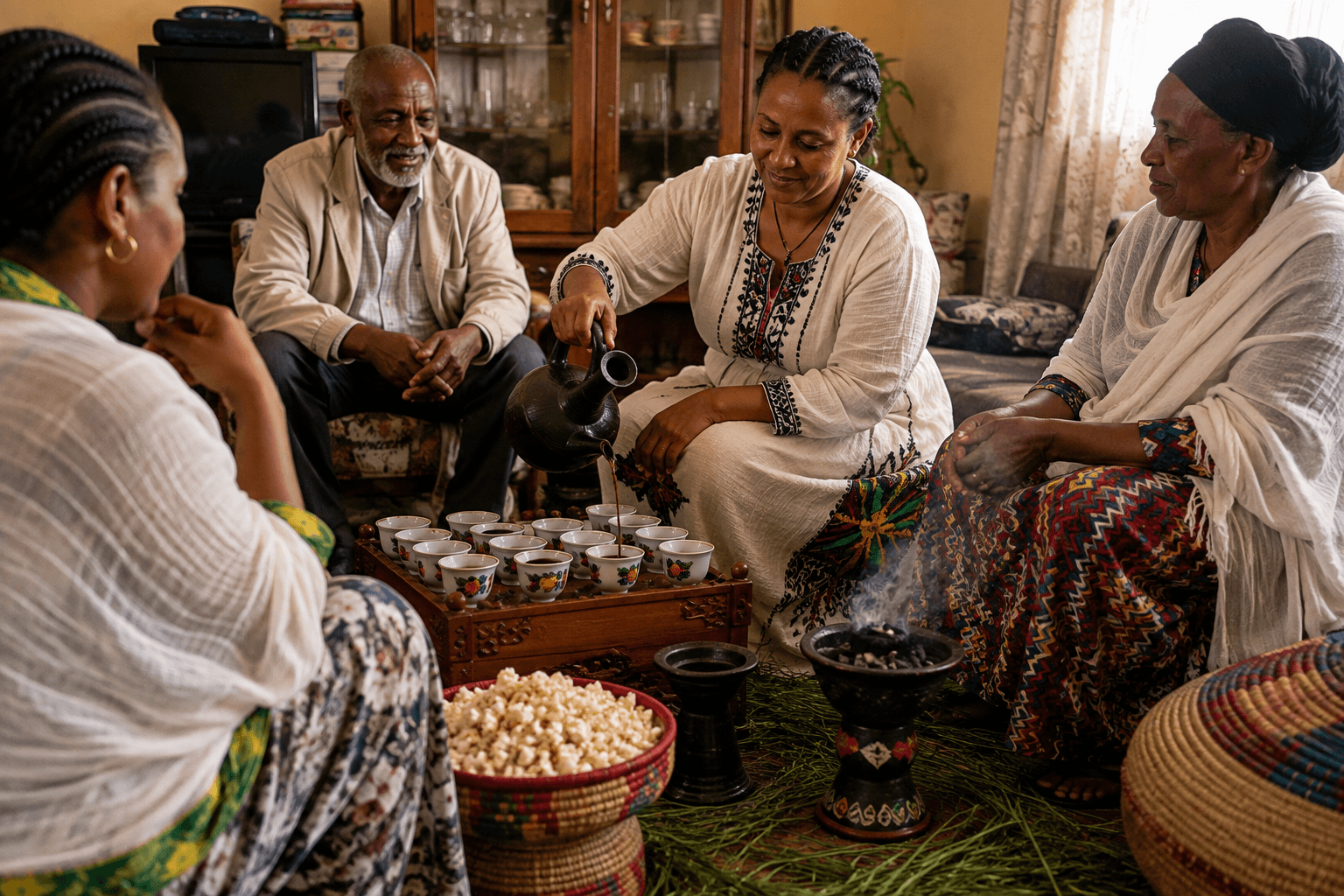
There is a moment during an Ethiopian coffee ceremony when you realize that the coffee is almost beside the point.
The beans may still be roasting. Someone is talking across the room. A neighbour has appeared without much ceremony. Children wander in and out. There may be incense burning, popcorn or another small snack on the table, and absolutely nobody seems particularly concerned about how long all of this is taking.
That is precisely the idea.
In a world where coffee increasingly means a paper cup grabbed on the way to work, the Ethiopian coffee ceremony asks you to do something rather unfashionable: sit down.
And stay for a while.
Coffee in Ethiopia is not simply caffeine. It can be hospitality, conversation, friendship, family time and, sometimes, the unofficial local news service.
Coffee in the Country That Gave It to the World
Ethiopia has one of the strongest claims to being the birthplace of Coffea arabica, and coffee occupies a place in Ethiopian life that is difficult to understand if you have only encountered it as a commercial drink.
In Amharic, coffee is buna, and a traditional coffee gathering is commonly called buna tetu — literally, “drink coffee.” You may also hear people refer simply to the coffee ceremony.
But “ceremony” can make it sound more formal than it necessarily is.
Yes, there are beautiful and carefully prepared ceremonies for guests and special occasions. But coffee preparation can also be an ordinary part of life: relatives talking, neighbours visiting, women exchanging news, or people simply spending an afternoon together.
The exact customs differ between households and communities, as you would expect in a country as diverse as Ethiopia.
What tends to remain constant is the importance of time and company.
It Begins With Green Coffee Beans
A traditional Ethiopian coffee ceremony often starts not with ground coffee but with green coffee beans.
The beans are washed and then roasted, traditionally in a small pan over heat. Slowly they change colour, becoming darker and shinier.
Then comes one of my favourite details of the ceremony.
The person roasting the coffee may carry the hot beans around so everybody can smell them.
You don’t need to be a coffee expert to appreciate this. Freshly roasted coffee has an extraordinary aroma, and when it mixes with incense in a room, it creates one of those smells that becomes associated with a place.
Only after roasting are the beans ground.
Already, you can see why this isn’t Ethiopian espresso.
Nobody is getting this done in 45 seconds.
The Jebena
The most recognizable object in an Ethiopian coffee ceremony is the jebena, the traditional clay coffee pot.
It has a rounded body, a long narrow neck and a pouring spout, although its shape varies somewhat by region and tradition.
Ground coffee and water are prepared in the jebena and brought to the boil. The coffee is then poured into small cups, often called sini, arranged closely together.
Pouring gracefully from a jebena takes considerably more skill than pushing a button on a coffee machine.
The cups are small and usually filled almost to the top. Depending on the household and individual taste, sugar may be offered. In some Ethiopian communities, coffee traditions can include salt or other additions rather than the sweet coffee many visitors expect.
And don’t expect a giant mug.
The cup may be tiny.
The conversation isn’t.
Why Are There Three Rounds of Coffee?
One of the best-known features of the traditional ceremony is that coffee can be served in three rounds.
They are commonly known as abol, tona (or huletegna in some usage) and bereka.
The first round is generally the strongest. More water is added for subsequent rounds, making the coffee progressively lighter.
The third round, bereka, has associations with blessing.
Does every Ethiopian sit through three rounds every time somebody makes coffee?
Of course not.
Modern Ethiopian life is modern life. People have jobs, appointments, traffic and phones ringing just like everybody else. In Addis Ababa, you can buy a quick macchiato in a café and be gone in minutes.
But the three rounds remain one of the traditions most closely associated with the full Ethiopian coffee ceremony.
If you are invited to one, therefore, don’t necessarily assume the first little cup means the event is finished.
You may only have started.
Coffee Is Also an Excuse to Talk
This is the part visitors sometimes miss.
Imagine that somebody invites you for coffee and then spends an hour preparing it.
From a purely practical perspective, this is spectacularly inefficient.
Socially, it makes perfect sense.
The preparation creates time.
While beans roast, people talk. While coffee brews, people talk. While the first round becomes the second, people are still talking.
Family news, neighbourhood gossip, work, marriage, children, politics, prices, religion — whatever people normally discuss eventually finds its way into the room.
Historically and socially, coffee gatherings have been particularly important spaces for women in many Ethiopian communities. But it would be wrong to imagine the ceremony as something only women participate in. Men, women, children, relatives, neighbours and guests may all be present depending on the occasion and household.
The ceremony provides a reason for people to be together without requiring them to do very much.
Perhaps modern life could use a little more of that.
What Is the Grass on the Floor?
Visitors sometimes notice fresh grass or greenery spread around the coffee area, particularly during a more traditional or carefully presented ceremony.
This isn’t decoration accidentally left behind by the gardener.
Fresh grass can be part of the presentation and helps create a welcoming, celebratory atmosphere. Incense is also common, and small snacks may be served.
Popcorn is especially familiar at coffee gatherings today, although other roasted grains or snacks can appear.
The result is wonderfully Ethiopian: coffee, incense, food and conversation all occupying the same small space.
It isn’t simply a drink being served.
A little environment has been created around it.
What Should a Visitor Do?
The easiest advice is also the best:
Relax.
You aren’t being tested on Ethiopian etiquette.
If somebody has invited you into their home for coffee, the invitation itself matters more than whether you know every custom.
Accept the cup with appreciation. Try the coffee. Compliment it if you enjoy it. Eat something if food is offered. Talk to people.
Most importantly, don’t behave as though you’re waiting impatiently for the ceremony to finish.
Constantly looking at your watch while somebody spends considerable time preparing coffee for you rather defeats the purpose.
You also don’t need to pretend to enjoy something you genuinely cannot drink. If caffeine, sugar or another ingredient is a problem, explain politely.
Ethiopian hospitality is supposed to make a guest comfortable, not imprison them beside a jebena.
Is the Ethiopian Coffee Ceremony the Same Everywhere?
No — and this matters.
Ethiopia contains more than 80 languages and enormous ethnic, religious and regional diversity. Coffee customs in an Oromo household, an Amhara household, a Gurage family, or communities in southern and southwestern Ethiopia may not be identical.
Urban and rural life differ too.
Nor does every Ethiopian family perform an elaborate traditional ceremony every day.
Some people prepare coffee quickly. Some drink tea. Some go to cafés. Some families preserve elaborate traditions. Others combine modern and traditional habits.
There is no single Ethiopian household that can stand in for more than 100 million people.
That diversity is part of what makes Ethiopian coffee culture interesting.
Coffee in Modern Addis Ababa
If you visit Addis Ababa expecting coffee culture to exist only inside traditional homes, you will discover your mistake very quickly.
The capital has a thriving café culture.
You can drink traditional buna, espresso, macchiato and increasingly sophisticated specialty coffee. Ethiopia’s Italian encounter during the twentieth century also left an unmistakable mark on urban coffee habits, and the Ethiopian macchiato has developed a personality of its own.
It is perfectly possible to have a traditional coffee ceremony in the afternoon and an espresso at a modern café later.
Nobody sees a contradiction.
This mixture of old and new is one of Addis Ababa’s charms.
The Coffee Is an Invitation
You can reproduce the mechanics of an Ethiopian coffee ceremony almost anywhere.
Buy green beans. Roast them. Grind them. Find a jebena. Burn incense. Pour coffee into little cups.
But you can still miss the most important ingredient.
People.
The ceremony makes sense because somebody has decided that sitting with another human being is worth the time.
That might be a grandmother with her family, neighbours catching up, friends arguing cheerfully about politics, or a household welcoming somebody they have only recently met.
The coffee gives everyone a reason to remain in the room a little longer.
And perhaps that is the simplest way to understand an Ethiopian coffee ceremony.
You arrive thinking someone is offering you a drink.
What they are really offering you is time.