
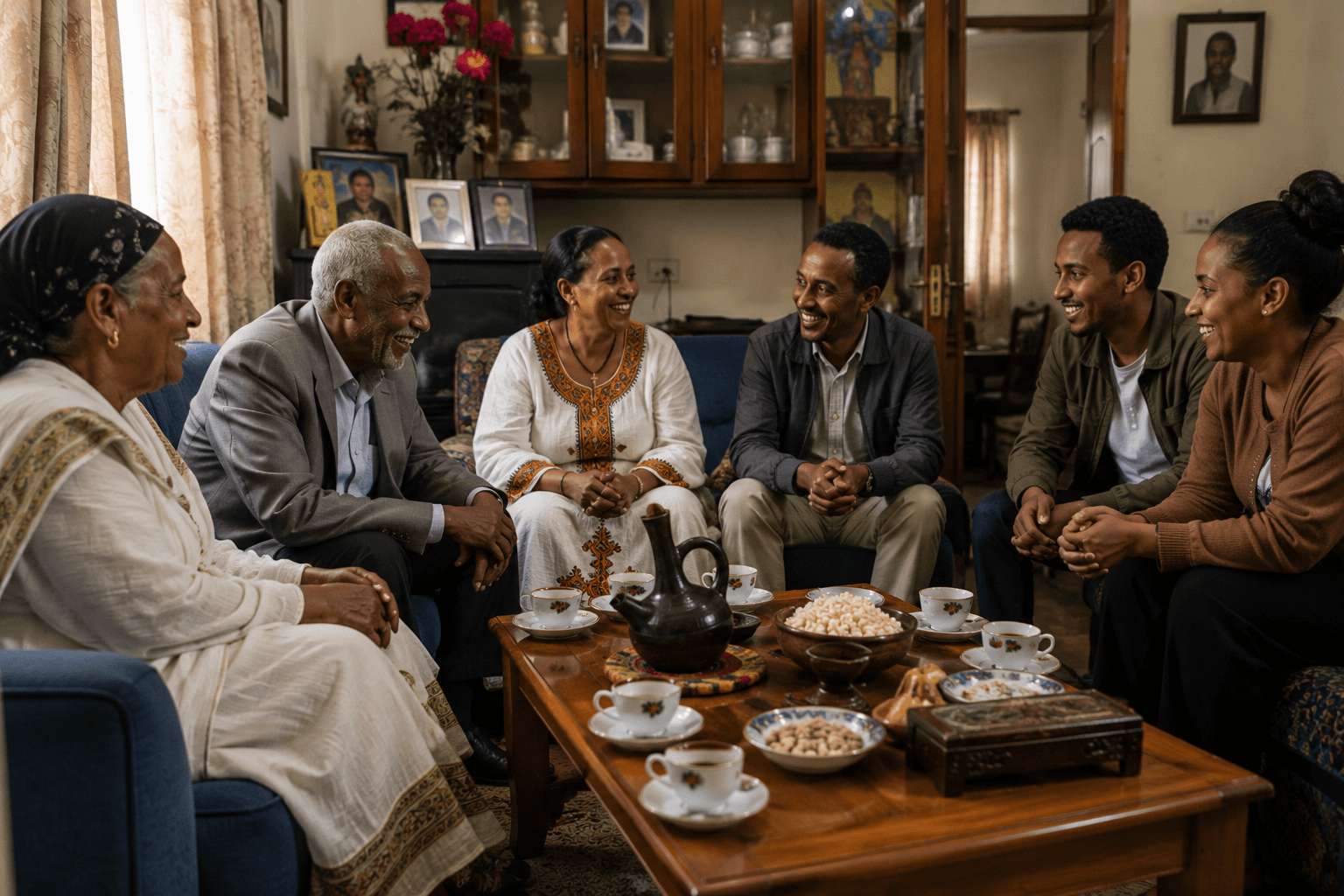
You have been invited to meet her family.
Good news.
Probably.
For someone dating an Ethiopian woman, that invitation can feel like a simple next step: go to the house, meet the parents, drink some coffee, be charming and try not to say anything stupid.
But depending on the woman, her family and the seriousness of the relationship, meeting an Ethiopian family for the first time can carry considerably more meaning than an ordinary social visit.
You may be meeting parents, brothers and sisters, cousins, an aunt who seems to know everything about everybody, and perhaps a grandmother quietly observing the entire operation.
Somebody will offer you food.
Then more food.
Then coffee.
You may explain that you’re full.
This information may be politely disregarded.
Welcome to the family visit.
There is no universal script for meeting an Ethiopian girlfriend’s family. Ethiopia is far too diverse for that. An urban professional family in Addis Ababa may approach dating very differently from a conservative household elsewhere, and religion, ethnicity, age, education and individual personalities matter enormously.
But there are some things worth understanding before you knock on the door.
First, Find Out What the Invitation Actually Means
This is probably the most important question.
Don’t assume.
For some Ethiopian women, introducing a boyfriend to the family is perfectly natural and doesn’t mean anybody is secretly measuring him for a wedding suit.
For others, particularly in more conservative families, introducing a romantic partner can indicate that the relationship has become serious.
Ask her beforehand.
Not:
“Does this mean we’re getting married?”
Perhaps something slightly less alarming.
Ask what her family knows about you. Do they know you’re her boyfriend? Do they think you’re simply a friend? Have they already heard about the relationship? Who is likely to be there?
This prevents one of the worst possible first-meeting situations: you believing everybody knows exactly who you are while her father thinks you’re a colleague from work.
Let her guide you.
She knows her family considerably better than you do.
Ethiopian Families Are Not All the Same
Any article claiming to tell you exactly how “Ethiopian families” behave should immediately make you suspicious.
Ethiopia is extraordinarily diverse.
Families can be Ethiopian Orthodox Christian, Muslim, Protestant, Catholic, followers of traditional beliefs or not particularly religious at all. They may be Amhara, Oromo, Tigrayan, Gurage, Somali, Sidama or from dozens of other communities.
Then add differences between Addis Ababa and smaller cities, between rural and urban life, between wealthy and working-class households, and between generations.
A 25-year-old Ethiopian woman working for an international company in Addis may have views about dating that are completely different from those of her grandmother.
Sometimes that difference exists inside the same living room.
So don’t arrive carrying a checklist of “how Ethiopians behave.”
Arrive prepared to meet these particular people.
Respect Matters More Than Performance
Foreigners sometimes become so worried about cultural etiquette that they behave as though they’re attending an examination.
Where do I sit?
Who do I greet first?
Can I cross my legs?
Should I shake hands?
What if I touch the injera incorrectly?
Relax.
Basic respect will take you surprisingly far.
Greet people properly. Pay particular attention to parents and older relatives. Don’t immediately disappear into your phone. Listen when people speak. Show interest in the family.
If your girlfriend tells you beforehand that her household follows a particular custom, take her seriously.
But nobody expects a foreign visitor to have grown up knowing Ethiopian etiquette.
Making a sincere effort is more important than performing every detail perfectly.
Learn a Few Words
If the family speaks Amharic, even a tiny amount can help.
Selam — hello.
Ameseginalehu — thank you.
You aren’t going to become fluent during the taxi ride to their house.
That’s fine.
Trying to greet somebody in their language communicates something beyond the literal meaning of the word.
It says:
I cared enough to learn this.
If the family speaks Afaan Oromo, Tigrinya, Somali or another Ethiopian language at home, ask your partner to teach you an appropriate greeting in that language instead.
Don’t automatically assume that every Ethiopian’s first language is Amharic.
Should You Bring a Gift?
Usually, bringing something modest is a nice idea when visiting someone’s home for the first time.
It doesn’t need to be expensive.
Fruit, chocolates, pastries or another small item suitable for the household can work well. If you’re arriving from another country, something characteristic of your home country can also make an interesting gift.
But ask your partner.
She will know what her parents would appreciate and whether there are religious or personal reasons to avoid particular things.
This is especially important with alcohol.
A bottle of wine might be perfectly welcome in one Ethiopian household and a spectacularly bad choice in another.
When in doubt, don’t improvise.
Prepare to Eat
Food is one of the easiest ways Ethiopian hospitality expresses itself.
If a family has invited you for lunch or dinner, they may have put considerable effort into preparing it.
You may encounter injera with several dishes: doro wat, tibs, shiro, vegetables, lentils or other foods depending on the household, occasion and religious calendar.
Traditionally, Ethiopian food is often shared from a communal platter and eaten using pieces of injera with the right hand.
If you’ve never done it before, don’t worry.
Watch everybody else.
Tear off a manageable piece of injera. Pick up some food with it. Attempt to deliver the entire construction to your mouth without redecorating your shirt.
Your first attempt may lack elegance.
Civilization will survive.
And Then Someone May Feed You
If you’ve read about Ethiopian dining, you may already know about gursha.
Someone wraps food in injera and feeds it directly to another person.
Within families and among people who are close, gursha can express affection, friendship and respect.
If a family member offers you one, don’t stare at them as though they’ve suddenly violated international dining law.
Accept it naturally if you’re comfortable.
It can actually be one of the nicest moments of the meal.
Coffee May Mean You Aren’t Leaving Yet
After the meal, you might be offered coffee.
This is where foreigners accustomed to a quick espresso can make a strategic error.
A traditional Ethiopian coffee ceremony takes time.
Beans may be roasted, ground and brewed in a jebena. Coffee can be served in several rounds. People talk. Snacks may appear. More conversation follows.
If you have somewhere else to be in twenty minutes, you planned badly.
Coffee in an Ethiopian home can be less about the beverage than about sitting together.
And if this is your first meeting with the family, that time is valuable.
The formal introductions are over.
People begin relaxing.
This is often when you actually start getting to know one another.
You May Be Asked Personal Questions
“How old are you?”
“What do you do?”
“Where does your family live?”
“Have you been married?”
“Do you have children?”
“What religion are you?”
And, depending on the circumstances:
“What are your intentions?”
Someone from a culture where such questions are considered extremely private may feel as though they’ve accidentally entered an immigration interview.
But questions about family, work, marriage and background can be perfectly normal when relatives are trying to understand who you are.
That doesn’t mean you must answer anything that makes you deeply uncomfortable.
But don’t automatically interpret direct questions as hostility.
They may simply be curiosity — or concern for someone they love.
Religion Can Matter a Lot
This is one area where you should not make assumptions.
Religion remains important in the lives of many Ethiopians, and it can become particularly significant when marriage enters the conversation.
An Orthodox Christian family may have expectations very different from those of a Muslim family. Protestant families may have their own expectations. Other households may barely care about religion.
Interfaith relationships certainly exist in Ethiopia.
So do families that strongly oppose them.
If you and your partner come from different religious backgrounds — or if one of you isn’t religious — this is something the two of you should discuss before the family begins discussing it for you.
The same applies to marriage ceremonies, children and religious upbringing.
These questions become considerably harder after an engagement.
Don’t Try to Impress the Family With Money
A foreign partner can sometimes walk into an Ethiopian relationship carrying assumptions about money that cause trouble.
Don’t make your first meeting a financial performance.
Expensive gifts, boasting about income or immediately offering to pay for things can create uncomfortable expectations and may even be interpreted differently from how you intended.
Generosity is good.
Showing off is something else.
Let the family meet you as a person.
If the relationship eventually becomes serious, discussions about finances, marriage, responsibilities and the future can happen honestly between adults.
You don’t need to arrive like a visiting bank.
Her Father Isn’t Necessarily Your Biggest Problem
Foreign men sometimes imagine meeting an Ethiopian girlfriend’s father as though they’ve wandered into a film.
Stern father.
Terrified boyfriend.
Protective daughter.
Interrogation.
Reality is usually much more ordinary.
Her father might be extremely friendly.
Her mother may be the one asking difficult questions.
Her grandmother may decide whether she likes you within thirty seconds.
Her brother may barely look up from his telephone.
Her aunt may conduct an investigation worthy of the intelligence services.
Families contain personalities.
Ethiopian ones are no exception.
Age Differences May Be Noticed
If there is a significant age difference between you and your Ethiopian partner, don’t imagine the family won’t notice.
They have eyes.
Some families won’t care much. Others may worry about compatibility, children, health, financial dependence or whether the relationship is genuine.
Those concerns are not automatically unreasonable.
Instead of becoming defensive, understand what is actually being asked.
A family may simply want reassurance that their daughter or sister is respected and that both people entered the relationship freely and understand what they want from it.
The best answer isn’t a speech.
It’s how you treat her.
Don’t Turn Ethiopia Into the Topic of Every Conversation
This sounds strange, but foreigners sometimes do it.
They arrive at an Ethiopian home and suddenly become an expert on Ethiopia.
They explain Ethiopian history to Ethiopians.
They announce their opinions about Ethiopian politics.
They compare everything with Europe or America.
They describe what “Africans” are like.
Please don’t.
Ask questions.
Listen.
Talk about yourself too. Your family, your work, where you grew up, what you enjoy.
You’re meeting people, not conducting anthropological fieldwork.
And unless you know the family very well, be cautious with Ethiopian politics and ethnic issues. These can be deeply personal subjects.
The first dinner is probably not the moment to solve the Horn of Africa.
What If They Don’t Like You?
It can happen.
Not every family welcomes every relationship.
The issue might be religion, nationality, age, previous marriage, children, money, personality or simply a parent’s hopes for their daughter.
Don’t immediately turn disagreement into a battle between “Ethiopian culture” and “Western freedom.”
And don’t force your partner to stage a dramatic confrontation on your behalf after one uncomfortable dinner.
Talk privately afterward.
Ask her what she thought.
Perhaps you misread the situation.
Perhaps the family needs time.
Perhaps there really is a serious objection that the two of you need to discuss.
Ultimately, an adult woman’s relationship belongs to her and her partner.
But pretending family opinion never matters can be unrealistic in a society where family relationships often remain important well into adulthood.
The Most Important Person Is Still Her
There is a danger in becoming so concerned about winning over the family that you forget why you’re there.
You aren’t dating Ethiopia.
You aren’t dating her parents.
You’re dating her.
Listen to what she tells you about her family. Don’t replace her actual experience with something you read online about “Ethiopian women.”
If she says her parents are relaxed, believe her.
If she says something will offend them, believe that too.
If she tells you not to bring wine, for heaven’s sake don’t arrive with a bottle because a travel blog told you gifts are polite.
Culture provides context.
The individual provides the instructions.
When the Visit Goes Well
The nicest family meetings are rarely the dramatic ones.
They’re the ones where, after an hour or two, everybody stops trying quite so hard.
Someone tells a joke.
Food gets passed around.
An older relative begins telling a story.
Your girlfriend looks considerably less nervous.
Someone pours another coffee.
Perhaps you understand only half of what is being said, but you understand enough.
And somewhere during all of this, you stop being the person she brought home and become Paulo, Michael, David, Ahmed — whoever you happen to be.
A person with a name.
That’s why the first visit matters.
Not because there’s a secret Ethiopian test you need to pass.
Because families everywhere tend to worry about people they love.
And sometimes the best way to make a stranger less frightening is simply to sit down, eat together and give them enough time to discover who you are.