
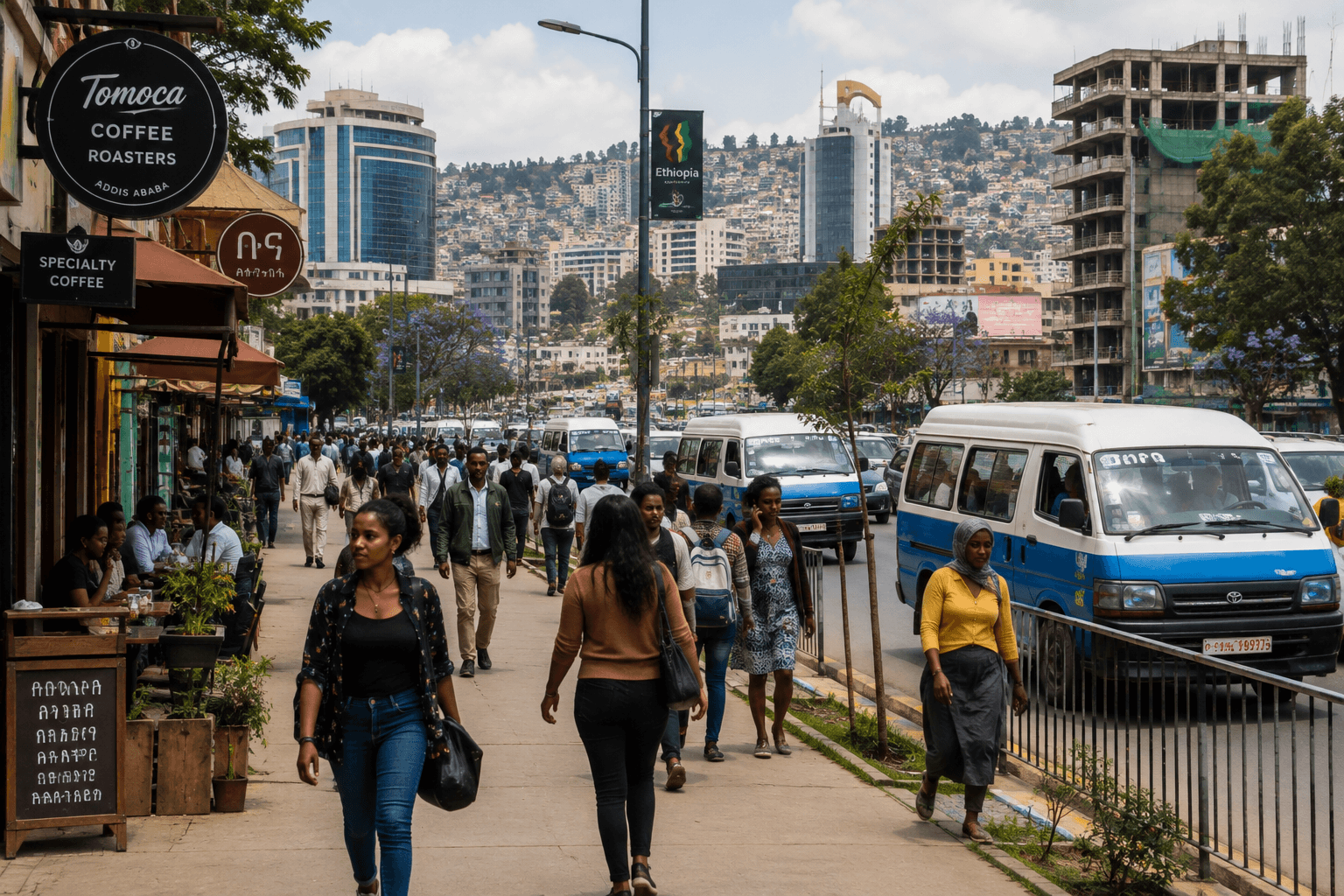
Your first surprise in Addis Ababa may happen before you’ve properly left the airport.
You came to Africa. Perhaps you expected heat.
Then you step outside at Bole International Airport on a cool Addis evening and wonder why nobody warned you to bring a jacket.
Welcome to a capital city sitting roughly 2,350 metres above sea level.
Addis Ababa has a habit of contradicting expectations. It is African but doesn’t always resemble the Africa imagined by first-time visitors. It is modern and chaotic, wealthy and poor, deeply traditional and relentlessly changing—sometimes on the same street.
There are new towers, unfinished buildings, tiny coffee shops, luxury hotels, roadside stalls, churches, minibuses, construction sites and people drinking macchiatos everywhere.
For somebody arriving in Ethiopia for the first time, Addis can initially feel confusing.
Give it a little time.
The city becomes considerably more interesting once you stop expecting it to behave like somewhere else.
Addis Ababa Is Much Higher Than You Think
One of the easiest facts to overlook when planning a trip to Addis Ababa is its altitude.
At around 2,350 metres above sea level, Addis is one of the world’s highest national capitals.
You may notice it.
Some visitors feel slightly breathless walking uphill during their first days. Others develop a mild headache or simply wonder why climbing stairs suddenly feels more impressive than it did at home.
Usually the sensible response is the simplest one: take things gently when you first arrive, stay hydrated and don’t plan your personal assault on every hill in Addis on the first afternoon.
The altitude also helps explain another surprise.
No, Ethiopia Is Not Always Hot
“Ethiopia is in Africa, therefore Ethiopia is hot.”
Geography has other ideas.
Addis Ababa’s altitude gives it a remarkably mild climate. Days can be pleasantly warm while mornings and evenings feel genuinely cool.
During the rainy season, particularly from June through September, Addis can be wet, grey and chilly enough to make an unprepared visitor reconsider his wardrobe.
A light jacket is useful.
So is an umbrella during the rains.
Ethiopia contains everything from extremely hot lowlands to cool mountains, so trying to describe the country’s weather simply as “African climate” doesn’t tell you very much.
Addis is a perfect introduction to that diversity.
Bole Is Not the Whole of Addis Ababa
Many foreign visitors first experience Addis through Bole.
This makes sense. The international airport is there, along with many hotels, restaurants, cafés, shops and businesses catering to travellers.
Bole is convenient and relatively easy for a newcomer.
It can also give you a rather incomplete idea of the city.
Travel farther and Addis changes.
Piassa has a completely different personality. Merkato is another world again. Residential neighbourhoods can feel surprisingly quiet compared with the traffic and commercial activity of the main roads.
Addis is less like one coherent city and more like a collection of neighbourhoods that happen to have grown into each other.
Don’t judge the entire capital from the road between your hotel and Bole Medhanealem.
Explore a little.
Coffee Is Everywhere
Eventually you will notice that Addis Ababa seems determined to ensure nobody remains insufficiently caffeinated.
Coffee shops are everywhere.
Some are modern cafés that wouldn’t look particularly out of place in Europe. Others are tiny local establishments. You may also encounter traditional coffee ceremonies in restaurants, hotels, homes and businesses.
And then there is the Ethiopian macchiato.
The Italian occupation of Ethiopia was brief, brutal and historically significant, but one quieter legacy is visible in Ethiopian café culture.
Espresso and macchiato became part of urban life.
Today, ordering a macchiato in Addis feels entirely Ethiopian.
You don’t need to spend your entire visit drinking traditional coffee from a jebena to experience Ethiopian coffee culture.
Sometimes sitting in a busy café with an Ethiopian macchiato and watching Addis go past the window tells you just as much about the modern city.
You Will Probably Eat Injera With Your Hands
Your first proper Ethiopian meal may arrive on a tray looking less like an individual dinner and more like a communal geography project.
At the bottom is injera, the soft, slightly sour flatbread traditionally made from teff.
On top are different stews, vegetables, meat dishes and sauces.
Then you discover there is no knife and fork.
That’s because the injera is also your utensil.
Tear off a small piece with your right hand, use it to pick up some of the food, and eat the whole thing.
It takes about thirty seconds to understand and considerably longer to become elegant at it.
Eating together from a shared platter is common and social.
One Ethiopian custom you may encounter is gursha, when someone feeds another person a bite of food by hand as a gesture of affection, friendship or respect.
If somebody suddenly approaches your mouth with injera, therefore, don’t automatically conclude that dinner has gone terribly wrong.
You may simply be receiving a compliment.
Ethiopian Food Is Much More Than Doro Wat
Doro wat is famous for good reason.
But don’t spend an entire trip eating only the dishes you already recognise from Ethiopian restaurants abroad.
Try shiro, a chickpea or broad-bean stew that can be wonderfully comforting.
Try tibs, pieces of sautéed meat served in numerous variations.
If you eat raw or lightly cooked meat and are comfortable doing so, kitfo is one of Ethiopia’s most distinctive dishes, traditionally prepared from finely minced beef seasoned with spices and clarified butter.
And pay attention to fasting food.
The Ethiopian Orthodox fasting tradition has produced an extraordinary range of plant-based dishes because observant Christians avoid meat and animal products during numerous fasting periods.
Foreign vegetarians and vegans sometimes arrive expecting Ethiopia to be difficult.
Then they discover yetsom beyaynetu—a colourful assortment of fasting dishes served on injera—and become considerably happier.
Addis Traffic Has Its Own Personality
You may look at a map and think:
“That’s only a few kilometres away.”
Addis traffic may have other plans.
Congestion can be serious, particularly at busy times, and construction or road changes can make journey times unpredictable.
There are taxis, ride-hailing services, blue-and-white minibuses and the Addis Ababa light rail.
For a first-time visitor, app-based or arranged transport can be easier until you understand the city.
The minibuses are cheap and deeply embedded in daily life, but routes aren’t necessarily obvious to someone who has just arrived.
And addresses can occasionally be an adventure.
People may describe locations using landmarks rather than the neat street-and-number system you expected.
You gradually learn that knowing near what? can be more useful than knowing the theoretical address.
The City Is Changing Astonishingly Fast
Return to Addis after several years and parts of the city can be difficult to recognise.
Construction has transformed large areas.
Old buildings disappear. Roads change. New commercial developments rise. Entire neighbourhoods can feel caught between an older Addis and whatever the city is becoming next.
This transformation is exciting for some residents and painful for others.
Modernisation creates infrastructure and investment, but redevelopment can also disrupt communities and erase familiar parts of the city.
A visitor sees cranes and new buildings.
A resident may see the place where a favourite shop, house or neighbourhood once stood.
Both perspectives are part of contemporary Addis Ababa.
Amharic Helps, Even If You Know Only a Little
You can manage many situations in Addis using English, particularly in hotels, restaurants, tourism businesses and among many educated younger Ethiopians.
But learning a few words of Amharic changes interactions.
Selam is an easy place to begin: hello.
Ameseginalehu means thank you.
Don’t worry if your pronunciation isn’t perfect.
The effort itself often produces a smile.
At the same time, remember that Ethiopia is multilingual. Amharic is enormously important and is widely used in Addis, but it is not the only Ethiopian language.
Oromo, Tigrinya, Somali, Afar and many other languages are spoken across the country.
Language in Ethiopia is connected to culture, region, history and identity. Treat it with curiosity rather than assuming everybody’s story begins and ends with Amharic.
Religion Is Visible
Religion is difficult to miss in Addis Ababa.
Ethiopian Orthodox churches are prominent throughout the city. You may see people making the sign of the cross as they pass a church, hear religious music or preaching, or encounter large crowds during religious celebrations.
Mosques and Protestant churches are also part of the city’s religious landscape.
Ethiopia has ancient Christian and Islamic traditions, and faith remains an important part of everyday life for many Ethiopians.
Visitors don’t need to share those beliefs.
They should respect them.
If you enter a religious site, observe how people around you behave and follow local requirements concerning shoes, clothing and photography.
And don’t photograph worshippers as though they are exhibits.
Ethiopian Time Can Confuse You
Here is a particularly Ethiopian surprise.
Someone tells you to meet at three.
You arrive at three.
There is nobody there.
Before deciding that the entire country has abandoned you, check which clock everyone is using.
Ethiopia traditionally counts daytime hours beginning around sunrise. What many international clocks call 7:00 in the morning corresponds roughly to one o’clock in Ethiopian daytime reckoning.
Likewise, 1:00 in the afternoon can be described as seven o’clock Ethiopian time.
International time is widely understood, especially in hotels, aviation and businesses dealing with foreigners, but Ethiopian time remains part of everyday life.
When an appointment matters, confirm.
“Three o’clock international time?”
That small question can save a remarkably long wait.
And Yes, Ethiopia Has a Different Calendar
The clock isn’t finished with you yet.
Ethiopia also uses its own calendar.
The Ethiopian calendar has 13 months: twelve months of 30 days followed by a short thirteenth month of five days, or six in a leap year.
Its year numbering is also roughly seven to eight years behind the Gregorian calendar, depending on the part of the year.
This is the origin of the famous tourism slogan describing Ethiopia as the country of “13 months of sunshine.”
For visitors, international hotels, airlines and tourism businesses will generally make dates understandable.
But seeing a completely different year written on a receipt or document can be wonderfully disorienting the first time it happens.
You haven’t travelled through time.
You have simply arrived in Ethiopia.
People May Ask Personal Questions
How old are you?
Are you married?
Do you have children?
What religion are you?
How much did something cost?
Questions that might feel surprisingly personal in parts of Europe can arise much more casually in Ethiopia.
Usually, there is no intention to interrogate you.
Different cultures draw the line between “personal” and “normal conversation” in different places.
You don’t have to answer anything that makes you uncomfortable.
But understanding that the question may not carry the same social weight it does at home prevents unnecessary offence.
You are also completely entitled to ask questions yourself.
Curiosity works in both directions.
Hospitality Can Be Persistent
If an Ethiopian host tells you to eat, saying “no, thank you” once may not end the negotiations.
There may be more food.
Then coffee.
Then somebody notices your coffee cup is empty.
Then food reappears.
Hospitality in Ethiopia can be wonderfully persistent.
A visitor from a culture where one polite refusal is immediately accepted can misunderstand this dance.
Sometimes the first refusal is itself part of politeness.
You don’t need to eat until medical assistance becomes necessary. Just understand the generosity behind the insistence.
Addis Is Not a Safari Destination
This sounds obvious, but expectations about Africa can be strange.
Addis Ababa is a major capital city.
People go to work, complain about traffic, study at university, date, buy phones, watch football, drink coffee, argue about politics, start businesses and worry about money.
You aren’t entering an anthropological museum.
Traditional Ethiopian culture is visible and important, but so are smartphones, Instagram, modern fashion, apartment buildings and young Ethiopians whose lives don’t fit a tourist’s idea of “traditional Africa.”
The interesting part is the coexistence.
An Ethiopian woman may attend an ancient religious celebration in the morning and spend the evening in a fashionable Addis restaurant.
Neither experience makes the other less authentic.
Don’t Try to Understand Ethiopia in Three Days
This may be the most useful advice of all.
Ethiopia is complicated.
Its history is unusually deep. Its politics can be sensitive. Ethnic and linguistic identities matter. Religion matters. Regional differences matter.
You will hear contradictory opinions about almost everything.
Listen.
Ask questions.
But be careful about becoming an Ethiopia expert after forty-eight hours because one taxi driver explained the entire country to you between Bole and Piassa.
The next taxi driver may explain it completely differently.
That is part of the education.
Give Addis Ababa Time
Addis isn’t necessarily a city that reveals itself instantly.
Some visitors fall in love with it immediately.
Others spend their first day staring at traffic, construction and unfamiliar streets wondering what exactly they are supposed to be enjoying.
Then something happens.
You find a café you like.
Someone starts a conversation.
You discover a restaurant hidden behind an unpromising entrance.
You spend an afternoon drinking coffee when you intended to stay twenty minutes.
You begin recognising neighbourhoods.
The confusion starts becoming familiarity.
That is when Addis gets interesting.
The city doesn’t need to match the Africa you imagined before you arrived.
It is much better when you allow it to be itself.